
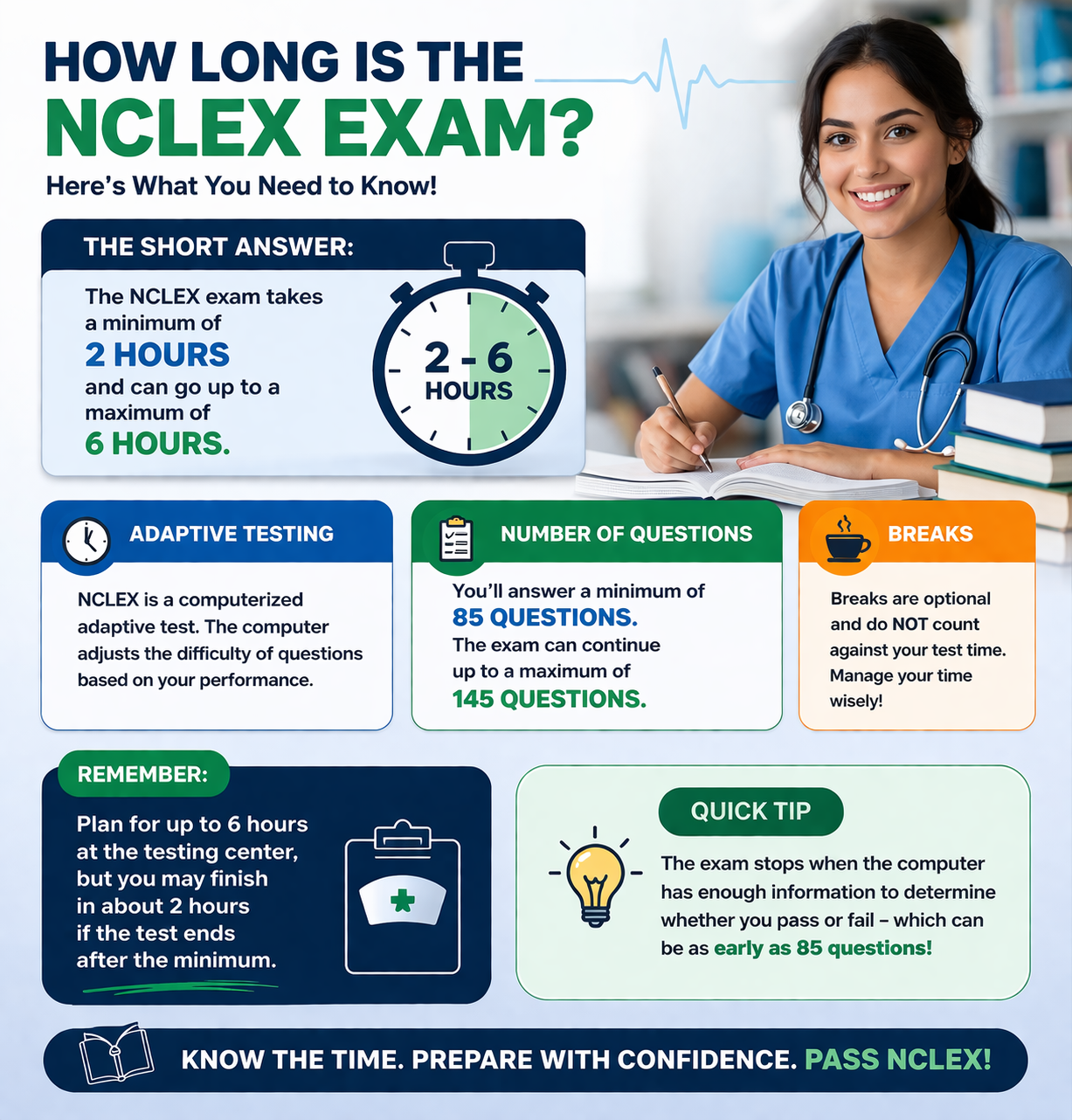
How long is the NCLEX exam? It’s one of the most common questions nursing students ask right before scheduling their test. The NCLEX (National Council Licensure Examination) determines whether you’re ready to practice safely as a Registered Nurse (RN) or Practical Nurse (PN) and understanding how much time you’ll have is crucial for confidence and pacing.
In this comprehensive guide, you’ll learn the NCLEX exam duration, how the computer-adaptive question system affects timing, and the best strategies to manage your time effectively during testing.
Understanding What the NCLEX Exam Is
Before diving into duration, it helps to understand what the exam measures. The NCLEX-RN and NCLEX-PN exams are standardized licensure tests created by the National Council of State Boards of Nursing (NCSBN). They evaluate your ability to apply critical thinking and clinical judgment in real-world nursing scenarios.
Unlike traditional college exams, the NCLEX doesn’t focus solely on memorization. It measures how you analyze patient data, prioritize care, and ensure safety all under real-time pressure. That’s why timing plays a big role: you must make confident decisions quickly and accurately.
Typical NCLEX Exam Duration
So, how long is the NCLEX exam? Let’s break it down by exam type.
NCLEX-RN Exam
- Minimum Questions: 85
- Maximum Questions: 150
- Time Limit: 5 hours total (including optional breaks)
- Average Duration: 3 to 4 hours for most test-takers
NCLEX-PN Exam
- Minimum Questions: 85
- Maximum Questions: 150
- Time Limit: 5 hours total (same as NCLEX-RN)
- Average Duration: 2.5 to 4 hours
While both exams share the same five-hour time cap, the total number of questions you receive depends on your performance. The computer ends the exam once it determines whether you’ve demonstrated enough competency to pass or not.
Understanding Computer Adaptive Testing (CAT)
The NCLEX isn’t a fixed-length exam like many others. It uses Computer Adaptive Testing (CAT), which means:
- The difficulty adjusts in real time based on your answers.
- If you answer correctly, the next question becomes harder.
- If you answer incorrectly, the next question becomes easier.
The test continues until the algorithm is 95% confident about your ability level compared to the passing standard. That’s why some people finish after 85 questions, while others go up to 150.
CAT testing impacts both duration and intensity you might finish in two hours or need the entire five hours.
NCLEX Test-Day Schedule
Your total testing time includes several segments:
- Check-In Process (15–30 minutes): Identity verification, palm vein scan, and photo.
- Tutorial: Optional brief guide on using the computer interface.
- Exam Session: Up to 5 hours total for answering questions.
- Breaks: Optional breaks at 2 hours and 3.5 hours—available whenever needed.
- Post-Test Survey: A short exit questionnaire at the end (optional).
It’s important to manage time proactively. Once the five-hour window expires, the test automatically ends even if you haven’t answered all questions.
Strategies to Manage Time on the NCLEX Exam
Proper pacing is essential for success. Here are proven time-management strategies for the exam:
- Don’t rush early questions. The first few determine your baseline ability level, so accuracy matters more than speed.
- Set internal checkpoints. Aim to complete about 30 questions per hour to stay on track.
- Avoid overthinking. Once you narrow down to two options, choose decisively prolonged second-guessing wastes time.
- Use breaks wisely. Stretch, hydrate, and reset if fatigue hits. A short pause can improve focus later.
- Watch the clock occasionally. Don’t obsess over it, but glance at intervals to gauge progress.
Example:
If you’ve answered around 60 questions after two hours, you’re pacing well. Slow down if accuracy feels off; speed up if doubts arise frequently.
How Question Volume Impacts Exam Length
Not all test-takers receive the same number of questions. Here’s how this variability influences timing:
- Short Exams (85–100 Questions): Usually 2–3 hours long. The algorithm quickly determines statistical competence.
- Medium Exams (100–130 Questions): Often standard; lasts 3–4 hours.
- Long Exams (131–150 Questions): May take 4.5 to 5 hours; ideal pacing is critical.
The number of questions doesn’t reflect performance directly some pass with the minimum, others with the maximum. The goal is consistency, not quantity.
What Happens If You Run Out of Time?
If the five-hour limit ends before completion:
- The system calculates your performance based on all answered questions.
- If your answers show overall competency above the passing standard, you pass.
- If the algorithm cannot confirm passing ability, you don’t pass.
This is why pacing matters rushing through the final 30–40 questions can lower your score even if you know the content.
Key Test-Taking Skills That Save Time
- Read each question once carefully. Most NCLEX items are precise; rereading excessively burns time.
- Use elimination wisely. Strike out clearly wrong options early.
- Prioritize safety. When unsure, choose the option that ensures patient safety first it aligns with NCLEX logic.
- Stay calm under pressure. Anxiety slows down reading and reasoning speed.
Building these habits during practice tests helps you finish smoothly without panic.
NCLEX Exam Experience: Realistic Expectations
On average, about 65–75% of first-time test-takers finish before the full five hours. The adaptive nature of the exam means you may exit earlier if you consistently perform above the pass threshold.
A common experience among nursing graduates:
“I finished at 95 questions and felt unsure. But two days later, I found out I passed!”
This illustrates how time and question count aren’t reliable indicators of success. Focus on reasoning and composure not clock watching
Preparing Mentally for Exam Duration
Time anxiety can undermine performance. To prepare:
- Simulate five-hour practice tests weekly.
- Train focus by studying in timed blocks (e.g., 60–question sets per hour).
- Build endurance with breaks mirroring the real exam schedule.
By conditioning your mind and pacing, you’ll go into the test confident, not rushed.
Final Thoughts: Timing Is Strategy
So, how long is the NCLEX exam? Up to five hours but success depends less on clock time and more on how you manage it. Whether your exam ends at 85 or 150 questions, your priority is maintaining consistent, safe clinical reasoning under pressure.
Master time management, stay calm, and remember: the NCLEX isn’t about speed it’s about smart, informed decisions. With focused preparation and a steady mindset, five hours is more than enough to prove you’re ready to be a licensed nurse.