
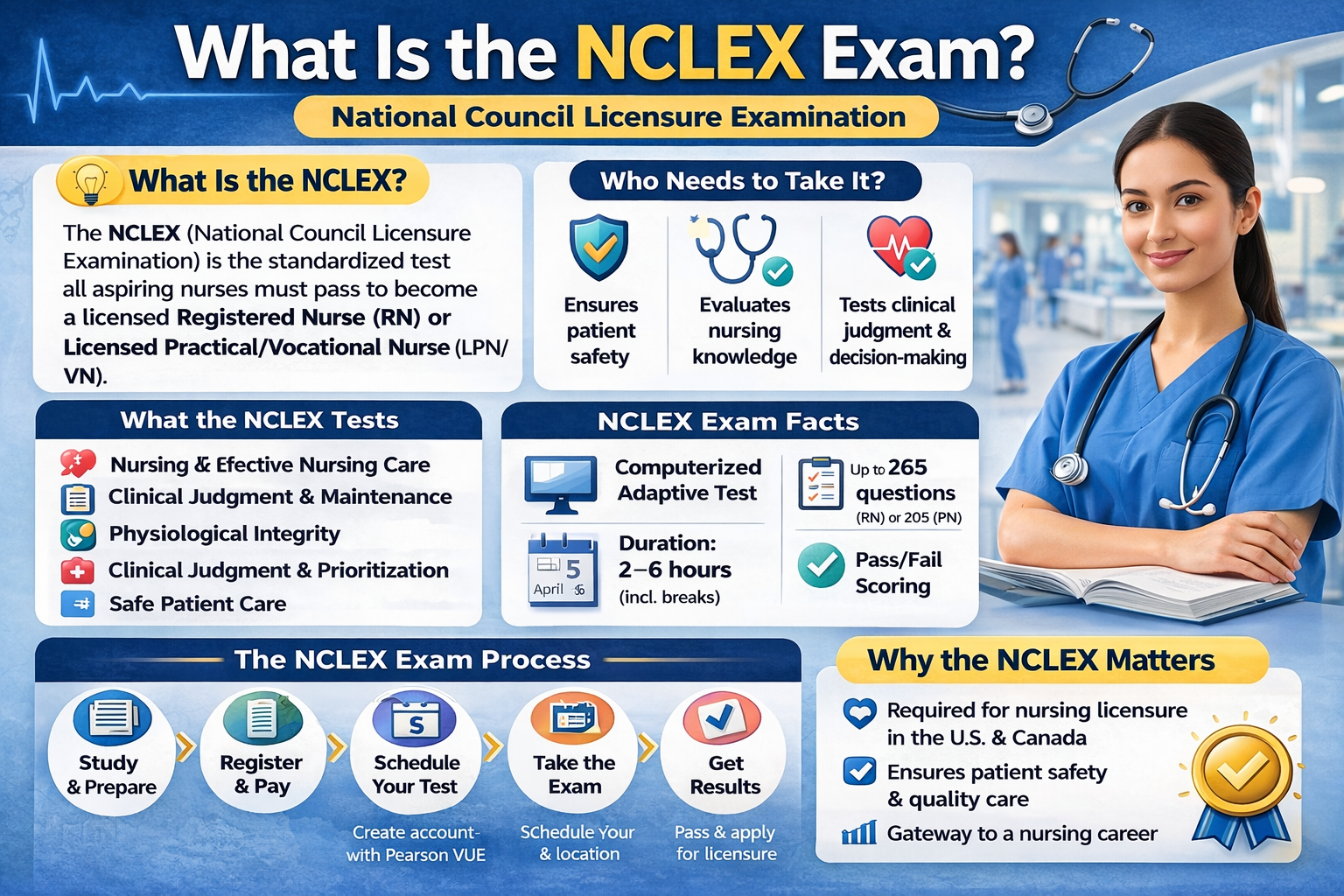
If you’re pursuing a career in nursing, one phrase you’ll hear repeatedly is “NCLEX exam.” The National Council Licensure Examination (NCLEX) is a critical milestone that determines whether you’re ready to safely and competently practice as a nurse in the United States or Canada. Whether you’re preparing for the NCLEX-RN (Registered Nurse) or NCLEX-PN (Practical Nurse), understanding what this exam entails and how to pass it is the key to unlocking your nursing license.
In this comprehensive guide, we’ll cover everything you need to know about the NCLEX: what it is, who needs it, how it works, its testing format, and proven strategies to help you succeed on your first try.
Understanding the NCLEX Exam
The National Council Licensure Examination is administered by the National Council of State Boards of Nursing (NCSBN). Its purpose is simple but vital: to assess if candidates have the knowledge, judgment, and practical nursing skills required to provide safe and effective patient care.
There are two main versions:
- NCLEX-RN — for individuals pursuing Registered Nurse licensure.
- NCLEX-PN — for candidates seeking Practical Nurse or Licensed Vocational Nurse status.
Both versions are designed to evaluate entry-level competence. Rather than testing you on pure memorization, the NCLEX measures your ability to apply critical thinking and make sound clinical decisions in complex healthcare settings.
Who Needs to Take the NCLEX Exam?
Anyone seeking nursing licensure in the U.S. or Canada must pass the NCLEX. After graduating from an accredited nursing program, candidates apply for licensure through their State Board of Nursing, receive authorization to test (called ATT), and then register with Pearson VUE, which administers the exam.
The NCLEX is required because it guarantees patient safety ensuring that only trained, competent, and ethical nurses enter the profession. Whether you’re a recent graduate or an international nurse looking to practice in the U.S., passing this exam is mandatory.
Exam Format and Testing Structure
One of the most distinctive features of the NCLEX is Computerized Adaptive Testing (CAT). This format adjusts the difficulty of each question depending on your previous answers.
Here’s how it works:
- If you answer correctly, the next question becomes more challenging.
- If you answer incorrectly, the following question becomes slightly easier.
- The goal: determine your true ability level as quickly and accurately as possible.
Exam Details
- Question Range: Between 85 and 150 questions (based on 2026 test plan updates).
- Test Duration: Up to 5 hours, including optional breaks.
- Question Types: Multiple-choice, drag-and-drop, fill-in-the-blank, and select-all-that-apply.
- Passing Standard: Determined by the NCSBN test plan; you pass if your ability consistently exceeds the set passing threshold.
This algorithm ensures every exam experience is tailored to the individual, minimizing chance and emphasizing competence.
Key Topics You’ll Encounter
The NCLEX-RN and NCLEX-PN exams are both rooted in four foundational areas of nursing practice. These reflect real patient care situations and safety standards.
- Safe and Effective Care Environment: Management of care, infection control, safety protocols.
- Health Promotion and Maintenance: Preventive healthcare, growth and development, lifestyle education.
- Psychosocial Integrity: Coping mechanisms, stress management, mental health interventions.
- Physiological Integrity: Pharmacology, surgical nursing, clinical procedures, and comfort measures.
Each topic requires not only clinical knowledge but practical reasoning showing the examiner that you can handle patient care responsibly under pressure.
Preparing for the NCLEX Exam: Proven Strategies
Preparation is the difference between passing confidently and feeling overwhelmed. Successful test-takers follow structured study habits tailored to the NCLEX format.
Step 1: Understand the Official Test Plan
Start with the NCSBN NCLEX Test Plan, a public resource outlining question areas, sample scenarios, and cognitive skill requirements.
Step 2: Use NCLEX-Style Practice Questions
The NCLEX is not like nursing school exams; it emphasizes reasoning. Try question banks from trusted providers like UWorld, Kaplan, or Simplenursing to strengthen critical thinking.
Step 3: Focus on Clinical Application
Instead of rote memorization, understand how concepts apply to patient care. For example, knowing why a medication is prescribed is more valuable than remembering its dosage.
Step 4: Simulate the Real Exam Environment
Train under timed conditions with adaptive tests. This helps manage exam anxiety and improves pacing.
Step 5: Review Rationales and Mistakes
Always learn from practice question explanations. Understanding the rationale behind each answer solidifies deeper comprehension.
Scoring and Results
After your exam, results are sent directly to your State Board of Nursing. Some states provide quick results within 48 hours, while others may take up to several weeks. Once you pass, your license number is issued, granting you authorization to practice as a nurse.
If you don’t pass, don’t be discouraged. You can retake the exam after a waiting period (typically 45–90 days). NCSBN encourages candidates to analyze score breakdowns and focus on weaker areas during re-study. Many successful nurses passed on their second attempt.
Why the NCLEX Exam Matters
Passing the NCLEX is more than a badge it’s a reflection of readiness and professionalism. It bridges the gap between academic nursing studies and real-world patient care responsibilities. Employers value NCLEX-certified nurses not just for their skills, but for the proven guarantee of competence and compassion the exam represents.
A strong NCLEX pass rate also elevates the reputation of nursing schools, making this exam an essential benchmark for both students and institutions.
Common Questions About the NCLEX
1. How difficult is the NCLEX?
It’s challenging but fair. With proper preparation and understanding of clinical reasoning, most candidates pass within two attempts.
2. How often does the NCLEX test plan change?
The NCSBN updates test plans approximately every three years to align with current healthcare standards.
3. Can international nurses take the NCLEX?
Yes, as long as their education meets U.S. Board of Nursing eligibility criteria.
4. What’s the best way to study?
Focus on application-based learning, use adaptive question banks, and take full-length mock exams under timed sessions.
Final Thoughts
The NCLEX exam is your professional milestone the test that says, “I’m ready to care for patients safely.” More than just a test of memory, it’s an evaluation of judgment, ethics, and decision-making in nursing practice. Whether you’re studying for the NCLEX-RN or NCLEX-PN, early preparation and understanding the exam’s structure will pave your way to success.
With persistence, smart study techniques, and confidence, you can pass the NCLEX and begin your journey as a trusted nursing professional.