
If you’re pursuing a career in nursing, passing the NCLEX exam is your final and most important milestone before becoming a licensed nurse. Whether you’re preparing for the NCLEX-RN or NCLEX-PN, understanding this exam’s purpose, structure, and strategies to succeed are crucial for launching your healthcare journey. In this guide, we’ll break down exactly what the NCLEX is, how it works, who needs to take it, and how you can prepare confidently to pass it on your first try.
What Does NCLEX Stand For?
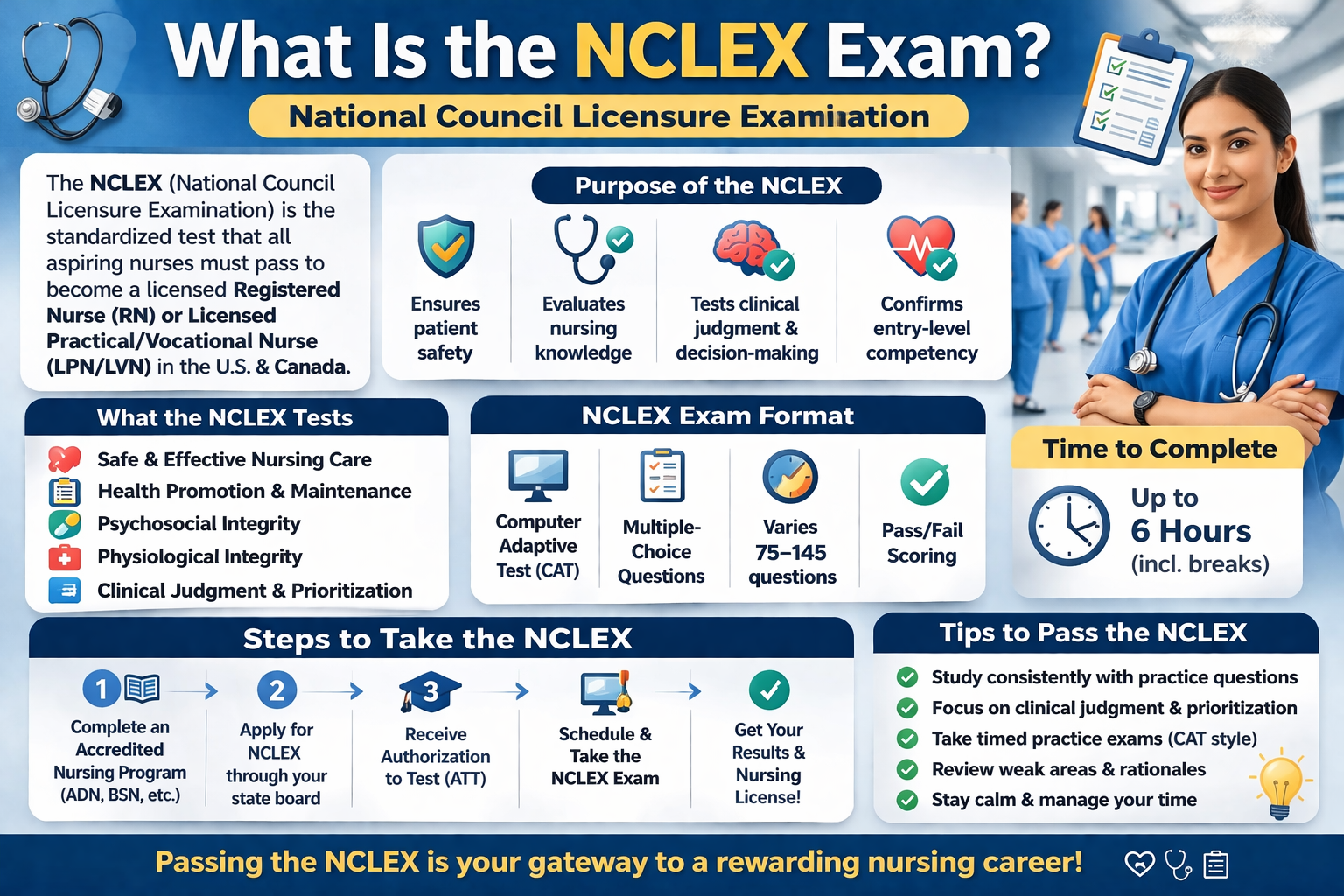
NCLEX stands for National Council Licensure Examination, developed by the National Council of State Boards of Nursing (NCSBN). The exam determines whether a nursing candidate is ready to practice safely and effectively as an entry-level nurse.
There are two versions:
- NCLEX-RN — for registered nurses (RNs).
- NCLEX-PN — for practical/vocational nurses (LPNs/LVNs).
Both exams assess your ability to make sound judgments in patient care, follow safety protocols, and apply evidence-based nursing knowledge.
Purpose of the NCLEX Exam
Unlike traditional academic tests, the NCLEX isn’t about memorizing facts. It evaluates whether you can think critically and apply nursing principles to real-world situations. The goal is to protect public safety by licensing only qualified nurses.
Passing the NCLEX proves you have the clinical reasoning, communication, and problem-solving skills necessary to handle patient care responsibly. This exam is not just a test it’s your professional gateway into the world of nursing.
Understanding the Test Format: What to Expect
Both versions of the NCLEX use Computer Adaptive Testing (CAT). This means the test adapts dynamically based on your performance: as you answer correctly, the questions become harder; if you answer incorrectly, the next question becomes easier.
The exam’s structure typically includes:
- Question Type: Mostly multiple-choice, plus alternate formats like fill-in-the-blank, drag-and-drop, and select-all-that-apply.
- Question Number Range: For NCLEX-RN, 85–150 questions; for NCLEX-PN, 85–150 questions (may vary depending on updates).
- Test Duration: Up to 5 hours, including scheduled breaks.
- Passing Standard: Determined by whether you consistently demonstrate competence above the required ability level set by NCSBN.
This adaptive method ensures every test is unique, highly personalized, and difficult to predict making preparation key.
Eligibility and Registration Requirements
To take the NCLEX, you must:
- Graduate from an accredited nursing program (RN or LPN/LVN).
- Apply for licensure through your state’s Board of Nursing.
- Receive an Authorization to Test (ATT) email after your application is verified.
- Register and schedule your exam with Pearson VUE, the official testing provider.
You can take the exam at authorized testing centers throughout the United States and internationally.
Topics Covered in the NCLEX
The NCLEX focuses on core areas of patient care and nursing practice. According to the NCSBN test plan, major topics include:
- Safe and Effective Care Environment — management of care, safety, infection control.
- Health Promotion and Maintenance — growth and development, prevention, and early detection.
- Psychosocial Integrity — coping, emotional health, crisis intervention.
- Physiological Integrity — pharmacology, medical-surgical nursing, and comfort measures.
Each question aims to test not only knowledge but also whether you can apply nursing principles to complex, realistic patient situations.
How to Prepare for the NCLEX Exam
Passing the NCLEX on your first try requires strategic preparation. Here are proven tips backed by successful test-takers:
- Start Early: Begin studying months before graduation using reputable NCLEX review books and online prep platforms.
- Understand the Test Plan: Review the official NCSBN test blueprint to know what areas carry the most weight.
- Practice with NCLEX-style Questions: Focus on critical thinking, not memorization. Apps and websites with adaptive questions help simulate the real exam.
- Use Official NCLEX Study Guides: Trusted sources like UWorld, Kaplan, or ATI Nursing offer full-length practice exams and rationales.
- Develop Test-Endurance: The NCLEX can last several hours, so practice enduring long testing sessions without losing focus.
- Review Rationales: When practicing, always study the reasoning behind correct and incorrect answers.
- Stay Healthy and Rested: Mental clarity and a calm mindset are just as important as knowledge.
Keep your goal in sight each question teaches you how to think like a professional nurse.
Understanding NCLEX Results and Retesting
After completing your exam, results are delivered through your state Board of Nursing, typically within a few days to a few weeks.
If you pass, you’ll receive your nursing license. If you don’t, don’t panic you can retake the test after a waiting period defined by your board (usually 45–90 days).
Failing the NCLEX isn’t a career ender; many successful nurses passed on their second or third attempt. The key is analyzing what went wrong and focusing on targeted study.
Expert Strategies to Boost Your Passing Score
To maximize your chances of passing:
- Focus on priority and delegation questions these often determine your competence level.
- Master pharmacology fundamentals drug names, side effects, and interactions are frequent questions.
- Join NCLEX study communities learn from peers’ experiences and share resources.
- Simulate real exam conditions practice in timed settings to manage anxiety.
Success on the NCLEX is 30% content and 70% mindset. Strategic study habits plus confidence equal passing success.
Why the NCLEX Matters for Your Nursing Career
Passing the NCLEX exam grants you the license to practice nursing professionally in the U.S. or Canada. Without it, even top nursing school graduates cannot work legally as nurses.
Your NCLEX score represents more than academic achievement it’s a validation of your readiness to care for patients safely and ethically.
This exam opens doors to:
- Registered Nurse positions in hospitals, clinics, and educational institutions.
- Advanced training opportunities like specialized certifications or graduate programs.
- Career mobility and higher salary potential.
In short, the NCLEX is where your educational effort transforms into professional freedom.
Final Thoughts
The NCLEX exam is a challenge but also an opportunity to prove you’re ready for one of the most trusted, respected professions in healthcare. With smart preparation, persistence, and a clear understanding of how the test works, you can pass confidently and take the next step toward your nursing career.
Focus on mastery, not memorization. Learn to think like a nurse, and the exam becomes just another day of doing what you’ve trained for—protecting lives.