
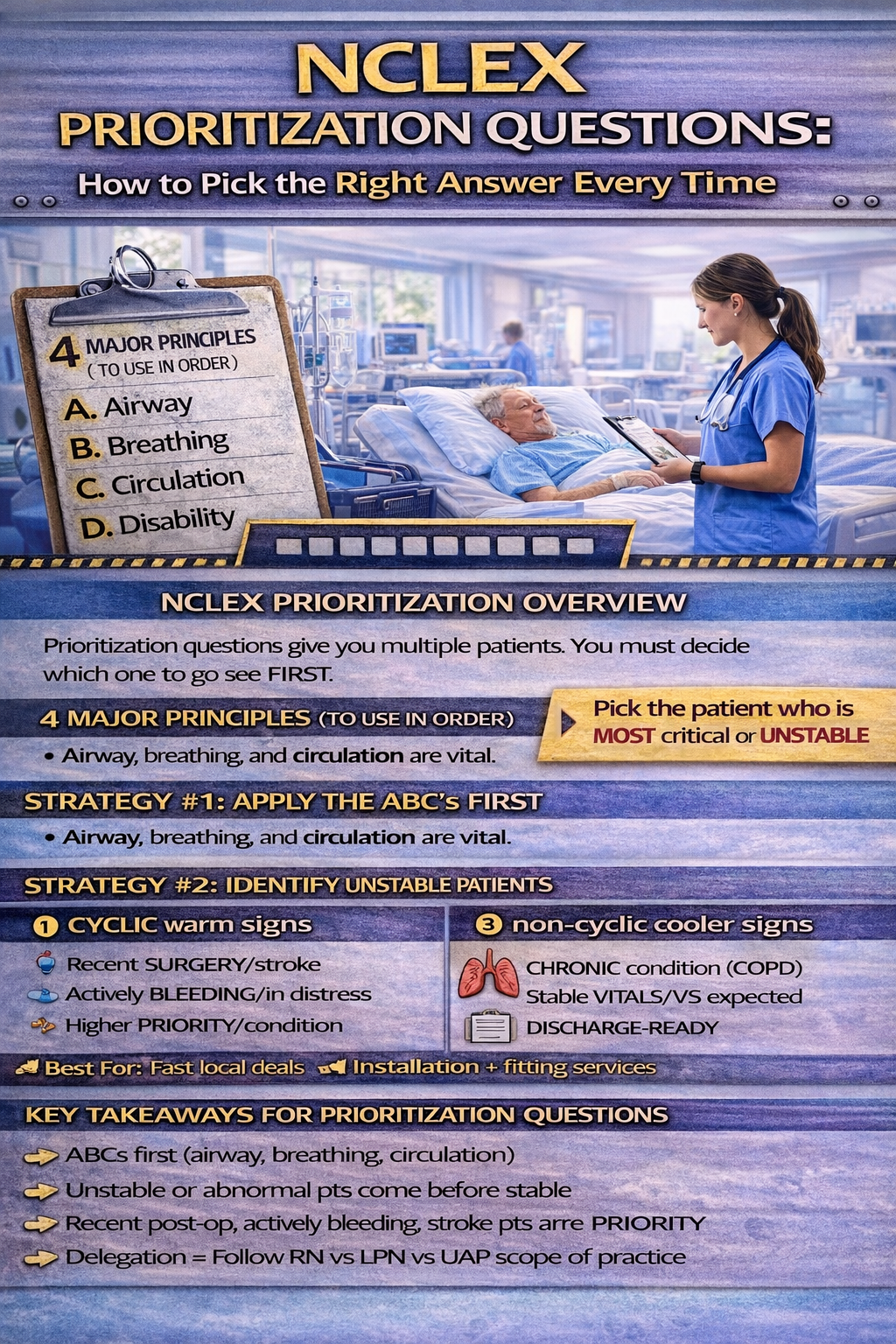
If NCLEX exam prioritization questions make you nervous, you are not alone. These questions are designed to test how you think as a nurse, especially when you must decide which patient comes first NCLEX and how to apply NCLEX delegation and prioritization principles under pressure.
The good news is that prioritization questions are very learnable. Once you understand the core rules, you can eliminate distractors faster and choose the safest answer with more confidence.
What NCLEX Prioritization Questions Test
NCLEX exam prioritization questions do not just ask what is “best.” They ask what is most urgent, most unsafe, or most appropriate to do first. This means you must think like a nurse who protects airway, breathing, circulation, and patient safety before anything else.
These questions often appear in forms such as:
- Which patient should the nurse see first?
- Which task should the nurse do first?
- Which finding requires immediate action?
- Which assignment is most appropriate?
The First Rule: ABCs Come First
The most reliable NCLEX exam strategy is to think in terms of Airway, Breathing, and Circulation. If one option involves a breathing issue, airway obstruction, active bleeding, chest pain, or shock, it is usually higher priority than a stable issue.
Use ABCs as your first filter:
- Airway: choking, stridor, inability to speak
- Breathing: shortness of breath, low oxygen saturation, respiratory distress
- Circulation: chest pain, bleeding, weak pulses, signs of shock
If two answers seem close, choose the one involving a more immediate threat to life.
Which Patient First NCLEX Strategy
When you see a “which patient first NCLEX” question, sort the options by urgency. A helpful order is:
- Unstable patients first.
- New or worsening symptoms next.
- Stable patients last.
- Routine care after urgent needs.
For example, a patient with new chest pain should be prioritized over a patient asking for discharge instructions. A patient with respiratory distress should be seen before a patient requesting pain medication refill.
Use the Safety First Rule
If none of the answers clearly involve ABC problems, ask yourself: Which option prevents harm? NCLEX exam often rewards the nurse who acts safely, not the one who acts fastest.
Safety-priority clues include:
- Fall risk
- Suicide risk
- Seizure risk
- Confusion or altered mental status
- Medication errors
- Post-op complications
If one answer prevents an injury, it often outranks a comfort-related action.
How to Handle NCLEX Delegation and Prioritization
A big part of NCLEX delegation and prioritization is knowing what the RN must do personally and what can be delegated. In general, the RN should handle assessment, evaluation, unstable patients, teaching, and care planning.
Delegate routine, predictable tasks to the appropriate team member when allowed, such as:
- Vital signs on a stable patient
- Hygiene care
- Ambulation assistance
- Routine specimen collection
Do not delegate:
- Initial assessment
- Patient teaching
- Evaluation of care
- Clinical judgment
- Unstable patients
When the question combines delegation and prioritization, ask:
- Is the patient stable?
- Does this task require nursing judgment?
- Is this an assessment or evaluation task?
- Can someone else safely perform it?
Common NCLEX Prioritization Traps
Many students miss prioritization questions because they choose the answer that sounds kind, efficient, or common. NCLEX is not asking what is nice to do; it is asking what is most important right now.
Watch out for these traps:
- Choosing a stable patient over an unstable one.
- Picking comfort over safety.
- Selecting a routine action before an urgent assessment.
- Delegating something that requires nursing judgment.
- Treating all patients as equal when one is clearly more acute.
A Simple Decision-Making Framework
Use this step-by-step approach on every prioritization question:
Step 1: Identify the problem
Ask whether the issue is airway, breathing, circulation, safety, or routine care.
Step 2: Look for unstable clues
Unstable patients come before stable patients. New symptoms matter more than old ones.
Step 3: Eliminate non-urgent answers
Remove options that are routine, delayed, or unrelated to immediate safety.
Step 4: Think like the RN
Choose the answer that protects life, prevents harm, or requires nursing assessment.
Practice Example
Question: Which patient should the nurse see first?
- A patient with a blood pressure of 118/74 and mild pain
- A patient with shortness of breath and oxygen saturation of 88%
- A patient asking for help with bedtime hygiene
- A patient waiting for discharge teaching
Best answer: The patient with shortness of breath and oxygen saturation of 88%.
Why? Breathing comes before comfort, teaching, and routine care.
How to Improve Fast
If you want to get better at NCLEX prioritization, practice with real decision-making habits:
- Read every question slowly.
- Underline unstable symptoms.
- Ask “What could kill or harm the patient first?”
- Review ABCs, safety, and delegation rules daily.
- Practice with mixed question sets, not just one topic at a time.
The more you practice sorting urgency, the easier these questions become.
FAQ
What is the best NCLEX prioritization strategy?
The best strategy is to use ABCs, safety, and unstable-before-stable thinking. These three rules solve many NCLEX prioritization questions.
How do I know which patient comes first NCLEX?
Choose the patient with the most urgent problem, especially if there is an airway, breathing, circulation, or safety risk.
How does delegation fit into prioritization?
Delegation helps you decide which tasks the RN must do and which can be assigned to others. Unstable patients and nursing judgment tasks stay with the RN.
Are NCLEX prioritization questions hard?
They can be challenging, but they become much easier once you learn the patterns behind the answers.