
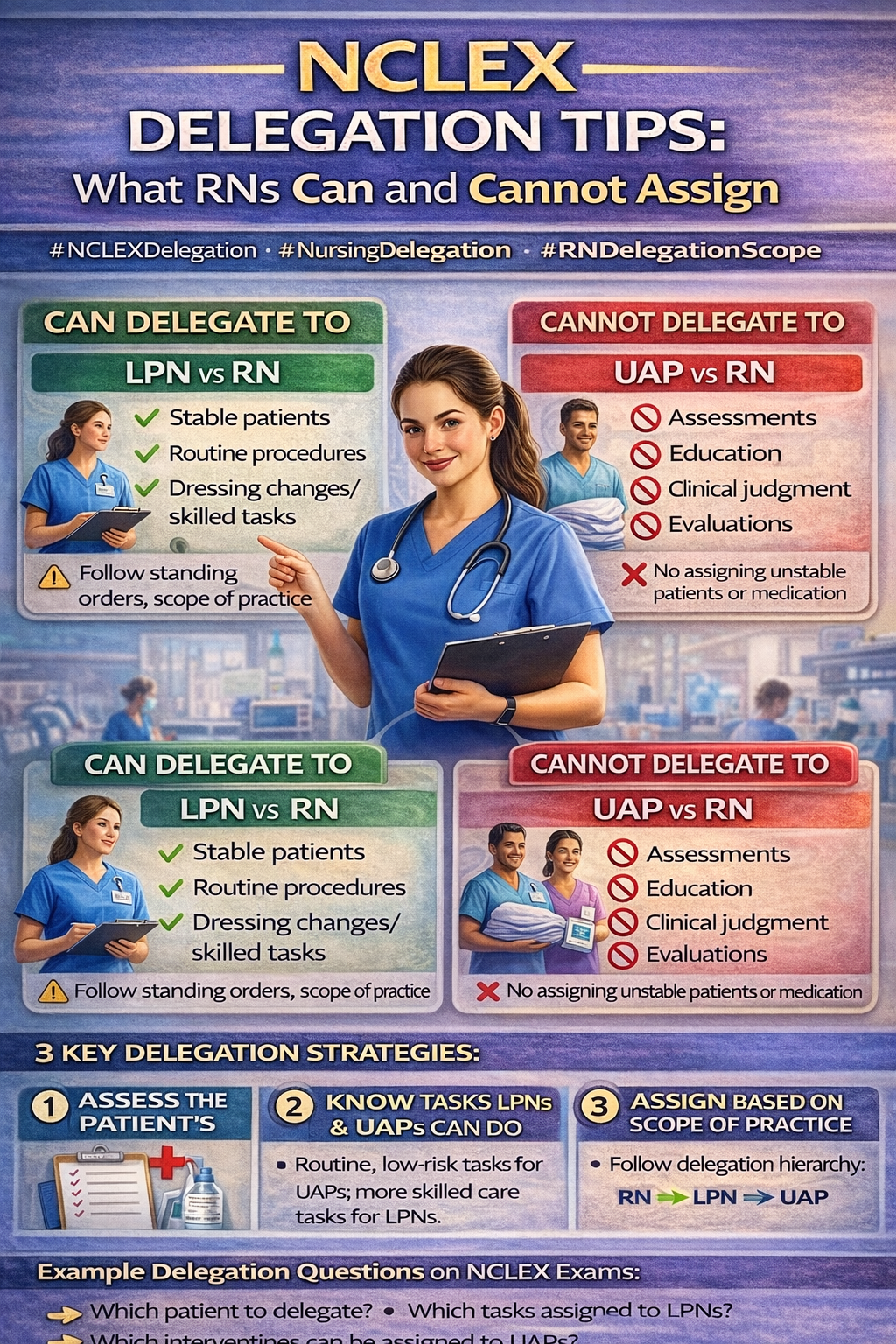
Understanding NCLEX Exam delegation is one of the best ways to improve your test score and build confidence as a future nurse. Delegation questions appear often because they test your ability to protect patient safety, follow RN delegation rules, and decide what tasks can be delegated to the right team member.
For NCLEX, the safest answer is usually the one that keeps the registered nurse responsible for assessment, judgment, teaching, and evaluation. If you can remember that simple rule, delegation questions become much easier.
What Delegation Means
Delegation is the process of assigning a task to another person while the RN remains accountable for the overall outcome. This means the nurse does not give away responsibility for patient care, even when a task is handed off.
On the NCLEX, delegation is not just about who is available. It is about who is qualified, what the patient needs, and whether the task is appropriate to assign.
What RNs Can Delegate
RNs can delegate tasks that are routine, predictable, and do not require nursing judgment. These are usually basic care activities that can be performed safely by trained assistive personnel or licensed practical/vocational nurses, depending on the situation and facility policy.
Examples of tasks that are often delegateable include:
- Ambulating a stable patient.
- Feeding a patient who does not have swallowing concerns.
- Measuring and recording vital signs on a stable client.
- Assisting with hygiene, bathing, and toileting.
- Turning and repositioning a patient.
- Collecting routine urine or stool samples.
- Basic intake and output documentation.
These tasks are commonly tested on NCLEX because they help determine whether the nurse understands what tasks can be delegated without risking harm.
What RNs Cannot Delegate
RNs cannot delegate tasks that require nursing judgment, assessment, teaching, evaluation, or care planning. These duties must stay with the RN because they involve clinical decision-making and direct accountability.
Tasks that generally cannot be delegated include:
- Initial assessments.
- Admission assessments.
- Teaching a patient or family.
- Evaluating whether a treatment worked.
- Triage decisions.
- Developing the nursing care plan.
- Interpreting abnormal assessment findings.
- Deciding if a patient is stable enough for discharge.
If the NCLEX asks what the RN should do first, the correct choice is often the action that involves assessment rather than delegation.
NCLEX Exam Delegation Rules to Remember
A simple way to approach delegation questions is to think about four things: task, person, patient, and communication.
Task
The task should be routine and predictable. If the task requires critical thinking, it usually stays with the RN.
Person
The delegatee must have the training and scope to perform the task. Do not assign something just because someone is free.
Patient
The patient must be stable. Unstable patients need RN-level care.
Communication
The RN must give clear instructions, define expectations, and know how and when to follow up.
Who Can Do What?
In many NCLEX Exam questions, the RN is choosing between an RN, LPN/LVN, and UAP.
- RN: assessment, teaching, evaluation, unstable patients, complex care.
- LPN/LVN: some medication administration, wound care, and monitoring stable patients, depending on policy.
- UAP: basic care, vital signs, mobility assistance, hygiene, and routine noninvasive tasks.
Always remember that policies can vary in real clinical settings, but NCLEX answers usually follow the safest general nursing principles.
How to Answer Delegation Questions on NCLEX
When you see a delegation question, ask yourself:
- Is the patient stable or unstable?
- Does the task require assessment or judgment?
- Is the task routine and predictable?
- Is the person qualified to do it?
- Will the RN still be responsible for follow-up?
If the answer involves a new patient, an abnormal change, teaching, or assessment, it usually belongs to the RN.
Common NCLEX Delegation Mistakes
Many students miss delegation questions because they focus on convenience instead of safety. The biggest mistake is assigning a task to the available person rather than the appropriate person.
Other common mistakes include:
- Delegating the assessment of pain, breathing, or neurological status.
- Asking an LPN to teach discharge instructions.
- Assigning unstable patients to UAP.
- Delegating tasks without clear instructions.
- Forgetting that the RN still must evaluate outcomes.
Quick Memory Trick
Use this easy rule:
RNs assess, teach, evaluate, and manage unstable patients.
Others may help with routine care for stable patients.
That one line can help you narrow down many delegation questions quickly.
Final NCLEX Delegation Strategy
When you are unsure, choose the answer that protects safety and keeps nursing judgment with the RN. NCLEX Exam delegation questions are built to test whether you can recognize the difference between routine task assignment and professional nursing responsibility.
The more you practice these questions, the faster you will recognize patterns. Focus on patient stability, task complexity, and scope of practice, and you will improve both accuracy and confidence.
FAQ
What is the most important rule for NCLEX delegation?
The RN should keep tasks that require assessment, teaching, evaluation, or nursing judgment.
Can an RN delegate assessment?
No. Assessment is an RN responsibility.
Can a UAP take vital signs?
Yes, for stable patients and routine situations, if allowed by policy and training.
Can an LPN teach a patient?
No. Teaching and discharge education are RN responsibilities.
What is the safest answer on delegation questions?
Usually the choice that protects patient safety, keeps unstable patients with the RN, and avoids assigning assessment or judgment tasks.