
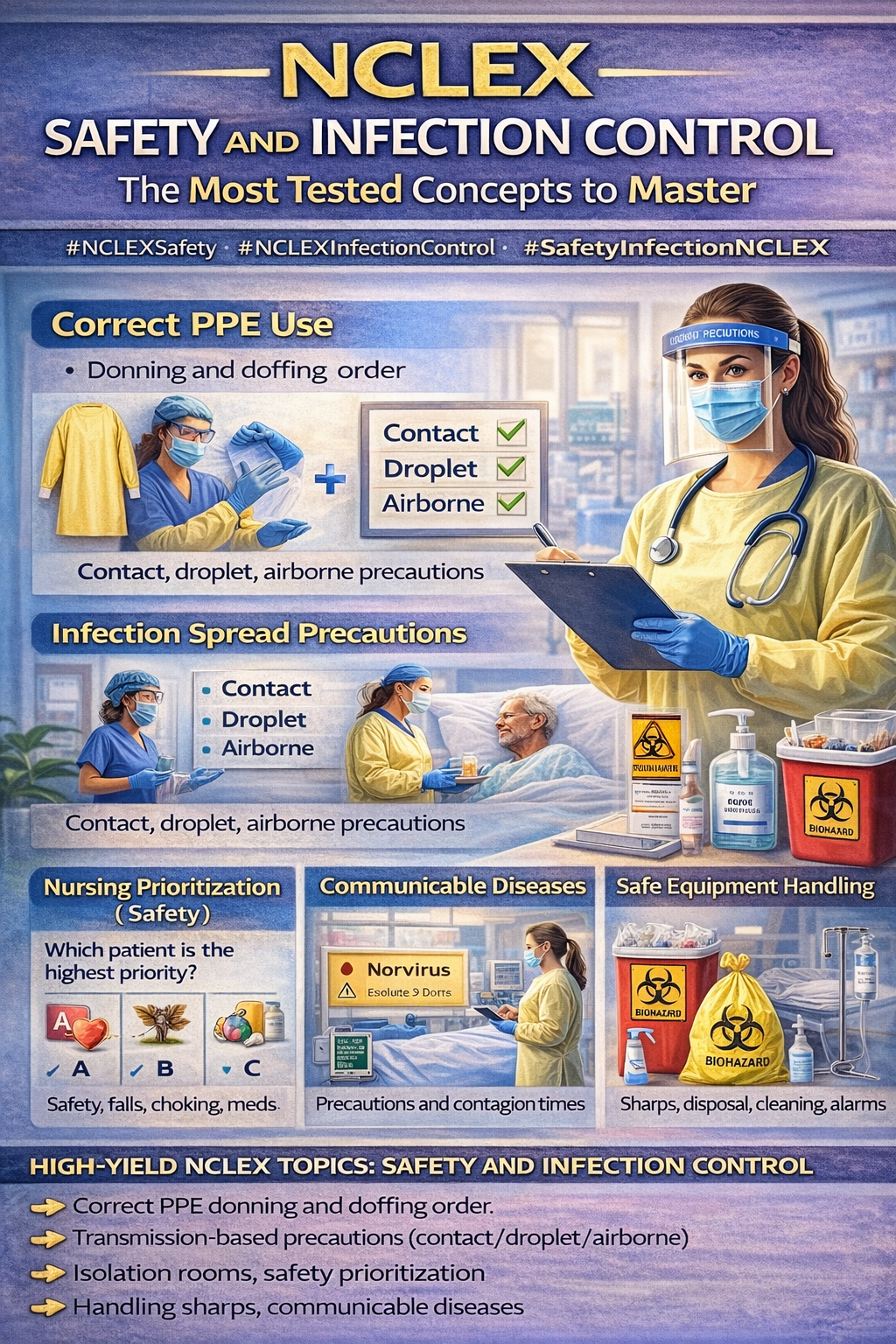
If you want to boost your NCLEX Exam score fast, start with safety and infection control. These topics show up often because they reflect real nursing priorities: protect the patient, prevent harm, and stop the spread of infection.
The NCLEX does not just test memorization. It tests whether you can think like a nurse and choose the safest action in a patient-care situation. That is why patient safety NCLEX questions and safety precautions NCLEX concepts are among the most important areas to study.
Why Safety and Infection Control Matter
Safety and infection control are high-yield because they appear in many parts of the exam, including prioritization, delegation, isolation precautions, and basic nursing care. These questions often involve choosing the action that prevents injury, avoids contamination, or protects a vulnerable patient first.
A strong understanding of these concepts can help you answer questions faster and with more confidence. If you know the rules for PPE, hand hygiene, isolation, fall prevention, and sterile technique, you can eliminate wrong answers more quickly.
Core NCLEX Exam Safety Concepts to Know
1. Hand Hygiene
Hand hygiene is one of the simplest and most tested infection-control practices. Use it before and after patient contact, after removing gloves, and after contact with bodily fluids or contaminated surfaces.
2. PPE and Isolation Precautions
Know when to use gloves, gowns, masks, and eye protection. You should also understand the difference between contact, droplet, and airborne precautions, since these are common NCLEX Exam infection control questions.
3. Sterile vs. Clean Technique
Sterile technique is required for procedures that must remain free from microorganisms, while clean technique reduces but does not eliminate organisms. The NCLEX Exam often tests whether you can identify when sterile fields have been contaminated.
4. Fall Prevention
Patient safety NCLEX questions frequently focus on fall risk, especially with older adults, sedated patients, and patients with mobility problems. Simple steps like lowering the bed, locking wheels, and keeping call bells within reach are high-yield.
5. Safe Medication Administration
Medication safety is closely tied to patient safety. You should know the rights of medication administration and understand how to prevent adverse events through double-checking, allergy assessment, and monitoring for side effects.
Infection Control Questions You Should Practice
The NCLEX often frames infection control as “what should the nurse do first?” or “which action is correct?” These questions may involve a patient with tuberculosis, influenza, C. diff, MRSA, or a wound infection.
A good strategy is to ask:
- Is the patient contagious?
- What type of precaution is required?
- What action protects the most vulnerable patient first?
- Is the nurse breaking sterile technique?
This type of thinking matches the clinical judgment style emphasized in current NCLEX preparation material.
How to Study These Topics Effectively
The best way to master NCLEX safety and infection control is to study them in short, repeated sessions. Review precautions, then complete practice questions, then explain why each correct answer is safest.
It also helps to group topics into categories:
- Infection prevention.
- Patient protection.
- Environmental safety.
- Isolation precautions.
- Medication safety.
When you study in groups like this, the information becomes easier to recall during exam pressure.
Common NCLEX Mistakes to Avoid
Many students miss questions because they choose the answer that sounds most advanced instead of the one that is safest. On NCLEX, the safest answer is often the correct answer.
Other common mistakes include:
- Confusing airborne and droplet precautions.
- Forgetting hand hygiene after glove removal.
- Breaking sterile technique without noticing.
- Failing to prioritize a patient at immediate risk.
If you avoid these errors, your performance on safety questions can improve quickly.
Final NCLEX Exam Safety Strategy
When you see a safety or infection control question, slow down and think in this order:
- Protect the patient.
- Prevent contamination.
- Prevent injury.
- Choose the action with the lowest risk.
That simple framework can help you answer many NCLEX questions correctly, especially when two options look similar.
FAQ
What are the most tested NCLEX safety topics?
The most tested safety topics include hand hygiene, PPE, isolation precautions, sterile technique, fall prevention, and medication safety.
Why is infection control important on the NCLEX?
Infection control is important because it reflects basic nursing priorities and patient protection, which are core NCLEX themes.
How should I study NCLEX safety questions?
Study by topic, then practice questions, and review why the safest answer is correct. Repetition and clinical judgment practice help the most.
Are NCLEX safety questions mostly memorization?
No. Many questions require you to apply nursing judgment and choose the safest action in a given situation.