
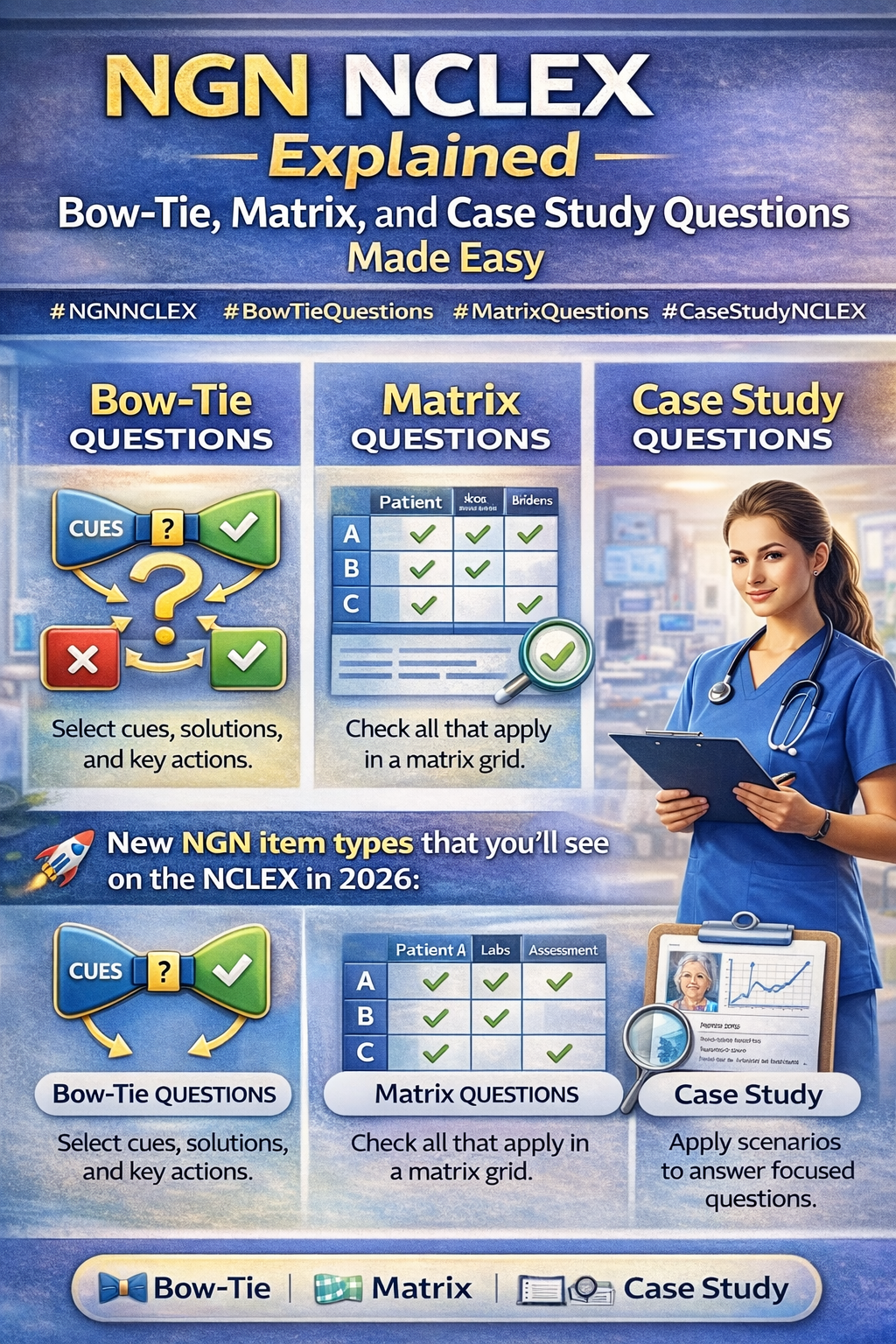
If you’re preparing for the NCLEX Exam in 2026, understanding NGN NCLEX question types is just as important as reviewing content. The Next Generation NCLEX focuses on clinical judgment, so bow-tie questions, matrix-style items, and NCLEX case studies are designed to test how you think, prioritize, and make safe nursing decisions.
In this guide, you’ll learn what each question type means, how to approach it, and how to improve your accuracy without getting overwhelmed.
What Is NGN NCLEX?
NGN NCLEX Exam stands for Next Generation NCLEX, the updated exam format that places more emphasis on clinical judgment. Instead of only testing memorization, it asks you to interpret patient information, identify risks, choose interventions, and evaluate outcomes.
This means nursing students need to go beyond “what is the diagnosis?” and focus more on “what should the nurse do next?” and “what is the safest action?”
Why NGN Questions Feel Harder
NGN questions often include more details, more answer choices, and more than one correct-looking option. That is why many students struggle with bow-tie questions and NCLEX Exam case studies at first. The exam is not trying to trick you; it is checking whether you can think like a nurse in a real clinical setting.
Once you understand the pattern behind the questions, they become much easier to manage.
Bow-Tie Questions Made Simple
Bow-tie questions are a newer NCLEX Exam format that asks you to connect a problem, an action, and an expected outcome. They are called “bow-tie” because the layout looks like a bow tie: one central clinical issue with related choices on both sides.
A simple way to approach bow-tie questions is to ask:
- What is the main patient problem?
- What actions are the best nursing priorities?
- What outcome shows the intervention worked?
How to Answer Bow-Tie Questions
Start by identifying the most urgent issue in the scenario. Then think about safety, ABCs, and priority nursing actions before looking at the outcome section. If the intervention does not logically match the problem, it is probably not the best choice.
For example, if a patient has shortness of breath, the priority is usually airway and breathing before comfort or teaching.
Matrix Questions Explained
Matrix questions ask you to evaluate several statements, findings, or actions across multiple rows and columns. Instead of selecting one answer, you may need to determine whether each item is appropriate, unsafe, expected, or abnormal.
These questions test whether you can organize information quickly and recognize patterns across a patient situation.
How to Handle Matrix Items
Read the question stem carefully and look for the category you are being asked to assign. Then work line by line instead of trying to answer everything at once. If you feel stuck, use elimination by comparing each statement to what is safe, normal, or expected in nursing practice.
A good tip is to slow down and treat each row as its own mini-question.
NCLEX Case Studies Explained
NCLEX case studies are one of the most important NGN formats. They present a patient scenario over multiple questions so you can show how your clinical judgment develops from assessment to intervention to evaluation.
These case studies often include lab values, vital signs, history, medications, and symptoms, so you must connect the clues instead of memorizing isolated facts.
How to Approach Case Studies
Use a step-by-step mindset:
- Identify the main problem.
- Gather the most important clues.
- Decide what is urgent.
- Choose the safest action.
- Evaluate whether the intervention helped.
This method keeps you focused and reduces the temptation to overthink every detail. Case studies reward students who can organize information logically and prioritize correctly.
Best Strategy for NGN Success
The best way to succeed on NGN NCLEX is to practice thinking in patterns. Ask yourself what problem is most urgent, what action protects the patient first, and what result proves the plan worked. This approach helps with bow-tie questions, matrix items, and case studies alike.
If you are studying for the NCLEX in 2026, build your practice around clinical judgment, safety, and prioritization rather than memorizing isolated facts.
Quick Tips to Improve Accuracy
- Read the full question before looking at the answers.
- Watch for keywords like “first,” “priority,” “best,” and “most appropriate.”
- Use ABCs, Maslow’s hierarchy, and safety principles.
- Do not choose answers just because they sound detailed or technical.
- Practice NGN questions regularly so the format feels familiar.
Common Mistakes to Avoid
Many students lose points because they answer too quickly or focus on one clue instead of the whole situation. Another common mistake is treating every NGN question like a content recall question instead of a clinical judgment question.
Remember: NGN NCLEX is not just about knowing facts; it is about applying nursing judgment safely and consistently.
FAQ
Are NGN questions harder than regular NCLEX questions?
They can feel harder because they are more detailed and require more reasoning, but they are manageable once you learn the pattern.
How many bow-tie questions are on NCLEX?
The exact number can vary by exam design, but bow-tie items are part of the NGN format and can appear as part of the test.
What is the best way to study for NCLEX case studies?
Practice identifying the main problem, then work through assessment, priority action, and outcome in order.
Do matrix questions have only one right answer?
Not always. Some matrix items require you to evaluate several statements individually, so each row should be treated separately.